The fabled patios of this Moorish fortress-palace in Granada,
constructed between the 9th and 14th centuries, still retain an
extraordinary sequestered atmosphere, especially if a visitor has the
foresight to plan a visit to avoid the crowds. Spaces such as the Court
of the Lions (late-14th century) are not gardens in the familiar sense,
in that they do not contain plants, but the sight and sounds of water,
the play of light and shadow and the decorative effects of the rich yet
delicate carving and stucco-work turn these outdoor living rooms into
works of art. Above the palace proper and across a gorge lies another
palace complex, the Generalife, which contains more greenery and is not
as formally organised. Its highlight is the celebrated long, rectangular
pool adorned with arching fountains in the Patio de la Acequia.
This Parisian park was created round a small château in the 1770s as
the result, it is said, of a bet between Marie-Antoinette and the Comte
d'Artois, whom she challenged to create a garden in two months flat. The
Scottish gardener Thomas Blaikie then took on the project and made a
picturesque English-style garden, the layout of which remains today
-although not all of his panoply of buildings, alas. The heart of the
garden, and its most beautiful part, is the rose garden designed in 1905
by Jean-Claude Nicolas Forestier. This is a feast for the rosarian,
with scores of delectable old French shrub roses in beds and on swags,
the whole given structure and height by clipped yew cones.
Bodnant, Wales

It was the 2nd Baron Aberconway who
largely created this extraordinarily ambitious terraced garden between
1904 and 1914. The site of the garden could hardly be bettered, with
views towards Snowdon, while the dramatic topography west of the house
was also exploited to the full. Here Aberconway created spaces such as
the Lily Terrace and the Canal Terrace. The latter features a delightful
18th-century building called Pin Mill (copied at another of our great
gardens: Quatre Vents in Canada). Aberconway's grandfather, Henry
Pochin, first laid out the estate from the 1870s. The Dell, in an
atmospheric ravine south of the house, contains Pochin's plantings of
conifers, complemented by Aberconway's Asiatic flowering shrubs -
wonderful magnolias and camellias among them - many of which were the
result of his sponsorship of the plant-hunting expeditions to China by
George Forrest and Frank Kingdon-Ward. The garden today is one of the
National Trust's finest horticultural treasures.
Courances, France

Is this the perfect example of the French formal garden? Created in the
mid-17th century - reputedly by Jean, father of the great Andre Le
Nôtre - the garden is filled with water in many moods, although it is
serenity that sets the tone. In front of the château, to the south, is
an elaborate box parterre that prefaces a perfect rectangular still
pool, surrounded by lawns and trees. This vista continues along a broad
grassy walk to a small circular pool with a statue of Hercules
(symbolising strength and virtue) and on to a larger pool and
amphitheatre. The woodland on each side of the main vista contains many
more delights, with allées cutting through and pools, canals and
cascades to discover. The other side of the house is dignified by a pair
of long rectangular canals. The singularity of the conception is what
appeals so much and lends this place its sublime beauty.
Crathes Castle, Scotland

The
late Graham Stuart Thomas reckoned that in its heyday under the care of
Lady Sybil Burnett, this garden was even better than Gertrude Jekyll's
own Munstead Wood, which Thomas had visited in her lifetime. It was Lady
Sybil's sureness of touch with colour that impressed, and the National
Trust for Scotland has done a good job of retaining something of that
sensibility in the garden today. Crathes was built for the Burnett
family in the 16th century, but the gardens as seen today are a largely
20th-century creation, on a seven-acre site on two levels, bounded by
old brick walls and fine old yew hedges. The turreted castle is a
constant background presence. Colour-themed borders - yellow, orange,
gold, white and silver - are very much in the mid-20th century style of
gardens such as Hidcote (the Burnetts were friendly with Lawrence
Johnston), and the whole composition works well as a complementary
series of episodes.
The Garden of Cosmic Speculation, Scotland
The architectural theorist Charles Jencks created this garden of turfed
terraces and imaginative sculptural incident, having been inspired by
the experiments in large-scale feng shui gardening (using a bulldozer)
of his wife, the late Maggie Keswick, who also wrote a fine book on
Chinese gardens. The centrepiece of Jencks's garden, and its stroke of
genius, is the massive S-shaped fractal terrace with pools and
associated spiral mound - a visually stunning and truly other-worldly
conception that has inspired a contemporary vogue for turf terracing in
landscape design in general. There are numerous other memorable moments,
such as the Symmetry Break Terrace (symbolising a black hole) and the
soliton-wave gates, which illustrate a principle of physical movement
first discovered in the 19th century by a scientist who noticed that the
tidal waves formed behind a canal boat continue even after the boat has
stopped, as a physical "memory".
Levens Hall, England
There has been much debate about the actual date of the celebrated yew
topiary forms at Levens Hall in Cumbria, which so captured the
imaginations of Edwardian garden writers. Current thinking errs on the
side of caution, dating much of it to the 19th century. On the other
hand, there is no doubt that a formal garden was first laid out here in
the early 18th century by James Grahme, a disaffected Tory squire who
was going against the contemporary fashion for Whiggish landscape
gardens replete with neo-classical buildings in a Virgilian pastoral
setting. Wandering through this garden at twilight is one of the most
evocative of all garden experiences; any description of the layout seems
superfluous because the whole point is to become deliciously lost. Beds
of perennials between the hedges, a nuttery and a herb garden top off
this beguiling scene.
Hidcote, England
The story is well-known. The American Lawrence Johnston and his mother
came to the Gloucestershire Cotswolds in 1907 and bought up an old manor
house at a time when this was just becoming a fashionable thing to do.
Lawrence developed a mania for gardening in general but - crucially -
not for horticulture alone. He may have been plant-mad, even nurturing
another garden (almost as important) on the French Riviera at Menton,
but he also instinctively understood the importance of design in any
garden that aspires to greatness. It is moves such as the pool garden at
Hidcote, where the brimming pool takes up almost the entirety of its
yew enclosure, and the twin pavilions prefaced by pleached hornbeams,
which mark it out as something special. The simple layout, with two
axes, has long been strengthened and shaped by the presence of large
cedars near the house.
Isola Bella, Italy
A garden that looks like a ship is worthy of celebration indeed, and
this extraordinary place - situated in the middle of Lake Maggiore and
accessible only by boat - does not fail to live up to expectations. It
was Count Carlo Borromeo's idiosyncratic vision in the 1630s which saw
this villa and garden constructed over a period of 40 years. The island
is oddly shaped and rises naturally at one end, which means that there
is no apparent rhyme or reason to the "formal" design of terraces and
parterres, which seem to multiply as one moves on. It is all dictated by
topography. From a distance it is the tobelisks on the highest terraces
that help lend such a ship-like air to the place, but when one is on
the island the series of six connecting grottoes beneath the palace
command the attention first, followed by the monumental stone "theatre"
topped by a statue of a unicorn.
Giverny, France
Claude Monet's dreamy garden in Normandy is extremely well maintained;
visitors can gain a sense of the symbiosis of his horticultural and
artistic interests (with the former always subordinate to the latter).
The main garden is set out on a grid with herbaceous plants - roses,
delphiniums, nasturtiums, foxgloves - and vegetables allowed to grow and
flower in super-abundance. Visitors must then pass beneath a railway
line (it has always divided Monet's garden in two) via an incongruously
bleak underpass, emerging into the water garden where the artist made
his famous studies of waterlilies. The arching green bridge, dripping
with wisteria, is a great cliche of garden design - a Mona Lisa moment -
but, like Leonardo's painting, it is well worth seeing and very much
holds its own amid the tyranny of expectation.
Little Sparta, Scotland
The poet and sculptor Ian Hamilton Finlay created this world-renowned
garden in the Pentland Hills near Edinburgh over the course of 40 years.
In many ways it is the summation of his work. Finlay died in 2006, but
the garden is in the hands of a trust that now allows visitors on a much
more regular basis than in Finlay's lifetime. Several hundred
sculptures and inscriptions entertain, intrigue or disturb visitors as
they follow a path through woodland and glades, past ponds and Finlay's
own "temple" to Apollo (a customised farm building). The imagery
oscillates between pastoral benevolence and militaristic malevolence -
everything from submarines and hand grenades to classical deities and
cosy comments on gardening appear here. The climactic view is across
Lochan Eck towards hills and fields, with an inscription carved on
massive stones before it: "The Present Order is the Disorder of the
Future". This is a garden that is as literary as it is visual, and (to
paraphrase Finlay himself) a place that is an attack just as much as it
is a retreat.
Giardino Giusti, Italy
In On the Making of Gardens (1909) Sir George Sitwell of Renishaw Hall
described the "intensely solemn loveliness" of this urban garden in
Verona, which takes a hold of most people who visit it (Goethe and John
Evelyn included). Tall, elegant cypresses at first seem to define it,
but the garden's several levels are most affecting on the ground, with
the flatness of the lowest accentuated by the smoothness of boxwood
parterres punctuated by modest fountains and statues. The garden was
originally laid out in the 1570s, with fountains, statues, grottoes and a
labyrinth, all of which survive. Later additions include a late
18th-century parterre in the French style, a woodland area with grotto
and decorative stone masks on the highest ground, together with a
belvedere offering views of the city. The subtle organisation of these
spaces chimes with a modern sensibility.
Het Loo, Netherlands
Very few grand 17th-century European Baroque gardens have made it into
this selection. The reason? While they may be important - "great", even -
they may not strike the visitor as excessively beautiful. The restored
palace of Het Loo near Apeldoorn is an exception because of the
(relatively) small-scale delight of its parterres, around what was
conceived in the mid-1680s as a hunting lodge in a forest for William of
Orange, who was about to become King William III of England. The
pre-eminent parterre designer Daniel Marot assisted in the design of the
parterres and the "King's" and "Queen's" gardens on opposite sides of
the house (such gender divisions were often used in house interior
layouts). The pleasures of tree-shaded canals are a particularly Dutch
addition to this satisfying formal landscape, comprehensively restored
in the 1980s in a pioneering project of its time.
Ninfa, Italy
After visiting this garden near Rome, many people list Ninfa as their
favourite garden of all. It has an atmosphere all its own, perhaps
because of the unique way it came into being. This has been a small town
from Roman times, and an ancient layout of lanes and bridges still
provides waymarking for visitors exploring the decorous dereliction all
around. Owned by the Caetani family (as it still is), Ninfa was sacked
in 1832 when the head of the family defied the Pope. It remained a ruin
until the early 20th century, when the family (with English additions)
returned, putting the sparkling river back into health and planting
flowers, trees and shrubs. Even in its derelict years, Ninfa had been
well known for its wildflowers. The town hall was converted into a
house, overlooked by a fortified tower that still stands sentinel. There
are carpets of cyclamens and other bulbous plants in spring, and later
hydrangeas, roses, clematis and numerous tender or rare species.
Latterly, it was Lelia and Hubert Howard who nurtured the garden and
helped make it into what it is today.
Rousham, England
Treasured as much for the idiosyncratic, defiantly non-commercial way
it is run (this private garden is still owned by the Cottrell-Dormers,
who built it in the 18th century), Rousham, in Oxfordshire, has earned a
special place in Britain's garden pantheon. Best known as a "William
Kent garden" made in the 1730s, the basic design was, in fact, laid out
by an under-sung master of the decade before, Charles Bridgeman. But
Kent added panache to this clever episodic layout overlooking the River
Cherwell. He even customised existing buildings beyond the boundaries of
the estate in order to "call in the countryside", to use the
contemporary phrase. Statues and statue groups, such as a copy of the
Dying Gladiator and Scheemakers' Lion Attacking a Horse, set the elegaic
atmosphere (Rousham's owner, General Dormer, had been badly wounded at
the Battle of Blenheim). The walled garden by the house is extremely
fine in terms of horticultural interest. Rousham is open every single
day of the year but there is no ticket booth, no shop, no restaurant and
(controversially) no children under 15 are allowed in.
Tarot Garden, Italy
The French-American artist Niki de Saint Phalle created this
extraordinary sculpture garden in Tuscany from 1978 until her death in
1998. Monumental figures, wittily realised in the artist's trademark
bright colours, amorphous shapes and mosaic-work, many of which also
serve as pavilions or small buildings, were based on tarot cards. The
artist lived inside The Empress for a number of years. The interior has
to be seen to be believed. The New Age subject matter and bright colours
lead many to dismiss this garden, having seen photographs alone - but a
visit is another matter. The integrity of the artist shines out and one
can only wonder at the sustained obsessional energy required to make
it. One interesting aspect of the garden is that the pieces have been
deliberately placed close together - crammed in, almost -so that the
whole space can be experienced in one sustained gulp.
Sissinghurst, England
The garden as
it stands today (it is rather smart) may bear little resemblance to how
it was in Vita Sackville-West's "ramshackle farm-tumble" time but
Sissinghurst in Kent is gardened to an extremely exacting standard,
satisfying most of its 200,000 annual visitors. The impossibly romantic
setting - a ruined Elizabethan castle - is hard to beat, and
world-famous set pieces such as the White Garden and the swags of
climbing roses over the walls are lovingly maintained by a devoted team
of gardeners. It is an overused word, but this really is a magical
place. Vita's husband, Harold Nicolson, had a big say in the layout of
the "garden rooms" which make up the whole, and is generally believed to
have had a restraining influence on Vita. However, as Adam Nicolson
revealed in Sissinghurst: An Unfinished History (HarperPress, £20),
Vita, in fact, had to tone down many of Harold's grandiose schemes.
Stourhead, England
For
many this is the greatest set-piece triumph of the 18th-century English
landscape movement, a garden of temples, grottoes and other mythical
moments set around a mystical lake that acts as its beating heart. This
landscape in Wiltshire was made at the behest of the banker Henry Hoare
(Hoare's Bank trades in London to this day), perhaps as a symbolic
journey through life, although much of the symbolism remains obscure or
does not connect up in the expected way. That was probably a deliberate
ploy on Hoare's part, for he needed (as a Tory) to remain socially and
politically ambiguous in order to earn the fabulous amounts of money he
made from his top-notch clients (mainly nepotistic or entrepreneurial
Whigs). This garden is often compared, with justification, to the
landscape paintings of Claude Lorrain, since there is a bridge, lake and
classical temple in the distance: a memorably romantic vision of
antiquity.
Mount Stewart, Northern Ireland
Making the most of its dramatic situation, the hilltop Temple of the
Winds by James "Athenian" Stuart that overlooks Strangford Lough is all
that survives of a great garden made here in the late 18th century for
the 1st Marquess of Londonderry. This is only the most striking feature
in what is otherwise an attractive and entertainingly idiosyncratic
garden (the eclectic garden round the house features concrete statues of
family political figures in the form of comical animals). In the 19th
century it was suggested to the 3rd Marquess that he might like to turn
the temple into a memorial for his son, the foreign secretary Lord
Castlereagh. Lord Londonderry admirably defended the spirit of the
building: "I have no taste for turning a temple built for mirth and
jollity into a sepulchre - the place is solely appropriate for a
junketing retreat in the grounds."
Powis Castle, Wales
This is a garden which inspires passionate devotion among a large
segment of the garden cognoscenti; it draws people back again and again.
Powis is an unusual fusion of a steeply terraced garden in the Italian
Renaissance tradition, with 20th-century herbaceous planting of the
highest quality. The terraces were created in the mid 17th century at a
time when the house, which started life as a 13th-century seat of the
Princes of Powis, was also being remodelled. What we see today is a
remarkable composition of multiple terraces of lawns, topiary and themed
borders, giving onto a massive lawn, then rising again into woodland,
with views of the fields beyond that. It is quite a spectacle. Original
18th-century statuary has survived here where it has been lost to so
many other gardens. The planting detail is much enjoyed and constantly
changing: colour is certainly not eschewed and fuchsias are in
abundance, together with pelargoniums, nasturtiums and a many more
tender specimens.
Studley Royal, England
John Aislabie was the Chancellor of the Exchequer when the South Sea
Bubble burst in 1720 - the first big stockmarket scandal. He was
vilified for his role in the debacle, sent to the Tower briefly and then
exiled to his North Yorkshire estate where, after stewing for some
time, set about improving his already emerging garden. The result is a
stupendous landscape garden set in a steep-sided valley, with smooth
lawns, still pools, serene temples and pure-white classical statuary in
the valley bottom (an Elysian scene) and a wilder feel on the wooded
valley sides, with temples hidden amid the trees. That is not all. The
climax of the garden is a surprise view, seen from above, of the ruins
of Fountains Abbey. To see this garden in the correct order, park at
Studley Roger rather than at the National Trust's car park. If pushed,
I'd have to say this is my favourite.
Vaux-le-Vicomte, France
This is the garden that so enraged Louis XIV that he had its owner
imprisoned. Finance minister Nicolas Fouquet, whose days were probably
numbered anyway, had also made the mistake of holding a series of
grandiose fetes in the late 1650s to mark the completion of his château.
The French King then hired the designer of this garden, Andre Le Nôtre,
to make something bigger and better for himself - Versailles, which may
be bigger than Vaux, but for most visitors is not better. At Vaux, Le
Nôtre was able to engineer a downhill view from the house that's as
satisfying as any in landscape design. Beyond a canal that cuts across
this main vista, stands an elaborate grotto, and then the land rises
again to a bronze statue of Hercules. This garden has been subject to
several phases of restoration, little of which is accurate. But Le
Nôtre's basic structure survives, and that is the most important
element.
Villandry, France
Casual visitors to this Loire Valley chateau will not guess that its
"quintessentially French" potager - albeit realised on an almost
surrealistically massive scale - was created in the early 20th century
by a Spanish-born doctor and his American wife, utilising what might be
described as a relaxed attitude to authenticity. None of that matters.
The garden is a visual, sensual triumph, with the vegetables in the nine
squares of the formal potager garden chosen as much for their looks as
their culinary value. This is the garden that made the ornamental
cabbage into a cult in the 1990s. Decorative structures called berceaux
(like large wooden pergolas) are sited at the corners of the potager,
covered in roses, while beyond this focal space are formal parterre
gardens containing clipped evergreen hedges, fountains and exuberant
herbaceous plantings. This is a garden that is beautiful -and
unashamedly good fun.
Villa Lante, Italy
For the majority of seasoned visitors, this garden just east of Viterbo
is simply the most sublime Renaissance garden experience of all - a
hillside water garden of the 1560s where the twin pavilions that act as
"the house" are absorbed by and remain subordinate to the rhythms of the
landscape design. And what rhythms these are - the water first emerges
from the gnarly Grotto of the Deluge at the top of the garden,
complemented by flanking Palladian loggias that act as small dining
pavilions. This tension between smooth rationality and rough nature is
continued throughout the design, with rationalism triumphing in the
large, ordered fountain parterre at the foot of the garden. Perhaps the
most memorable moment is the Fountain of the Table on the third level of
four, which consists of a long stone table with a central runnel down
its length. Cardinal Gambara, who commissioned the garden, made
reference to his family name by using the crayfish motif - "gambara"
means crayfish.
Worlitz, Germany
That Enlightenment progressive and garden-lover Prince Anhalt-Dessau
created this 300-acre garden near Dessau in the late 18th century partly
as a homage to the English landscape garden. Its inherent power and
beauty win it plaudits from all visitors. All the buildings and much of
the atmosphere of the place was directly inspired by a variety of
English gardens, including Stourhead, but its true genius lies in the
way the lakes, topography and woodland areas have been manipulated to
create different moods and vistas. In fact, water covers a third of the
available space. The prince's interest extended to new industry (there
is a copy of Shropshire's Iron Bridge in the northern part of the park)
and natural history - the most outlandish diversion here (sadly now
gone) was a miniature copy of Mount Vesuvius which was designed to light
up and spew out "lava".
Source By:
http://www.telegraph.co.uk/gardening/gardenstovisit/3349870/The-worlds-50-most-beautiful-gardens-Part-one-Europe.html  1. – The Keukenhof Garden – Netherlands
 2. – The Garden of Cosmic Speculation – Scotland
 3. – The Garden Suan Nong Nooch – Thailand
 Also known as the “Botanical Garden Fanchette Rischbieter” , the Botanical Garden of Curitiba is a garden located in the city of Curitiba, capital of Paraná, and the biggest city in the south
of Brazil . It is the major tourist attraction of the city and houses
part of the campus of the Federal University of Paraná. Opened
in 1991, Curitiba Botanical Garden was created in the style of French
gardens. Once on the gateway
shows French style gardens in the middle of sources
and waterfalls and lakes , and the main greenhouse of 458 square meters,
which houses inside, copies of characteristic plants from tropical
regions . It deploys its flower
carpet to the visitors right at the entrance. This garden
occupies 240.000 m² . The main greenhouse gases, in an Art Nouveau style
with a modern metallic structure, resembles the mid-19th century
Crystal Palace in London. Botanic Museum , which provides a national
reference collection of native flora, attracts researchers from all the
world. Includes many botanical species of moisture from the Atlantic
forest of eastern Brazil.
Also known as the “Botanical Garden Fanchette Rischbieter” , the Botanical Garden of Curitiba is a garden located in the city of Curitiba, capital of Paraná, and the biggest city in the south
of Brazil . It is the major tourist attraction of the city and houses
part of the campus of the Federal University of Paraná. Opened
in 1991, Curitiba Botanical Garden was created in the style of French
gardens. Once on the gateway
shows French style gardens in the middle of sources
and waterfalls and lakes , and the main greenhouse of 458 square meters,
which houses inside, copies of characteristic plants from tropical
regions . It deploys its flower
carpet to the visitors right at the entrance. This garden
occupies 240.000 m² . The main greenhouse gases, in an Art Nouveau style
with a modern metallic structure, resembles the mid-19th century
Crystal Palace in London. Botanic Museum , which provides a national
reference collection of native flora, attracts researchers from all the
world. Includes many botanical species of moisture from the Atlantic
forest of eastern Brazil.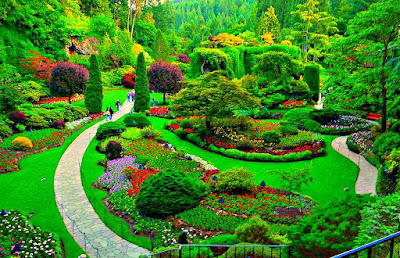
 Yuyuan is believed to be built in the dynasty Ming ,
more than 400 years. Built in traditional Chinese style with numerous
rocks, trees, ponds, dragon-lined walls and numerous gates and bridges
zigzag separates the gardens and several pavilions. In the past 400
years Yuyuan was restored and reopened several times. The garden was
renovated by the local rich, following several civil wars in
the nineteenth century caused huge damage. In 1956, after the liberation
of Shanghai, the city government rebuilt the garden and recovered its
elegance and beauty . Yuyuan Garden finally reopened to the public in
1961.
Yuyuan is believed to be built in the dynasty Ming ,
more than 400 years. Built in traditional Chinese style with numerous
rocks, trees, ponds, dragon-lined walls and numerous gates and bridges
zigzag separates the gardens and several pavilions. In the past 400
years Yuyuan was restored and reopened several times. The garden was
renovated by the local rich, following several civil wars in
the nineteenth century caused huge damage. In 1956, after the liberation
of Shanghai, the city government rebuilt the garden and recovered its
elegance and beauty . Yuyuan Garden finally reopened to the public in
1961. Shalimar is a Persian garden and it was built by Mughal emperor Shah
Jahan in Lahore, Pakistan. Construction began in 1641 Year of
Christ. (1051 AH) was completed the following year. The project management
was carried out under the supervision of Khalilullah Khan , a noble of
Shah Jahan’s court, in cooperation with Ali Mardan Khan and Mulla Alaul
Maulk Tuni. ‘s garden Shalimar s and presented in the form of a
rectangular parallelogram, surrounded by a high brick wall. The
gardens measure 658 meters north east south and west 258 meters. In
1981, Shalimar Gardens was included as a UNESCO World Heritage Site.
Shalimar is a Persian garden and it was built by Mughal emperor Shah
Jahan in Lahore, Pakistan. Construction began in 1641 Year of
Christ. (1051 AH) was completed the following year. The project management
was carried out under the supervision of Khalilullah Khan , a noble of
Shah Jahan’s court, in cooperation with Ali Mardan Khan and Mulla Alaul
Maulk Tuni. ‘s garden Shalimar s and presented in the form of a
rectangular parallelogram, surrounded by a high brick wall. The
gardens measure 658 meters north east south and west 258 meters. In
1981, Shalimar Gardens was included as a UNESCO World Heritage Site.


